
Fire Potential Wind Index (FPWI) is a discrete fire danger metric, ranging from one to four (low to extreme).
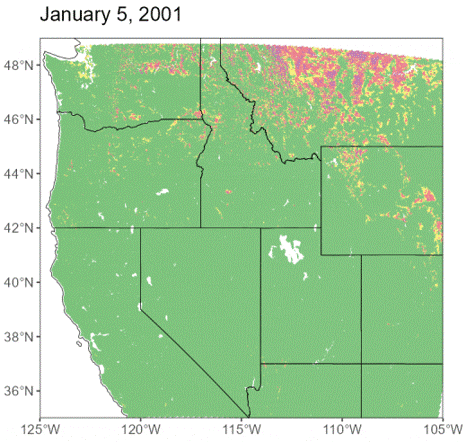

FPWI extends the FPIC framework to specifically address utility operational needs, particularly for Public Safety Power Shutoff (PSPS) decision-making, recognizing that wind is a critical driver of both powerline-related ignitions and rapid fire spread. FPWI was trained on thousands of historical power line fires and is purpose-built for utility use.
FPWI captures extreme wildfire conditions by combining two metrics:
-
Wind gust percentiles
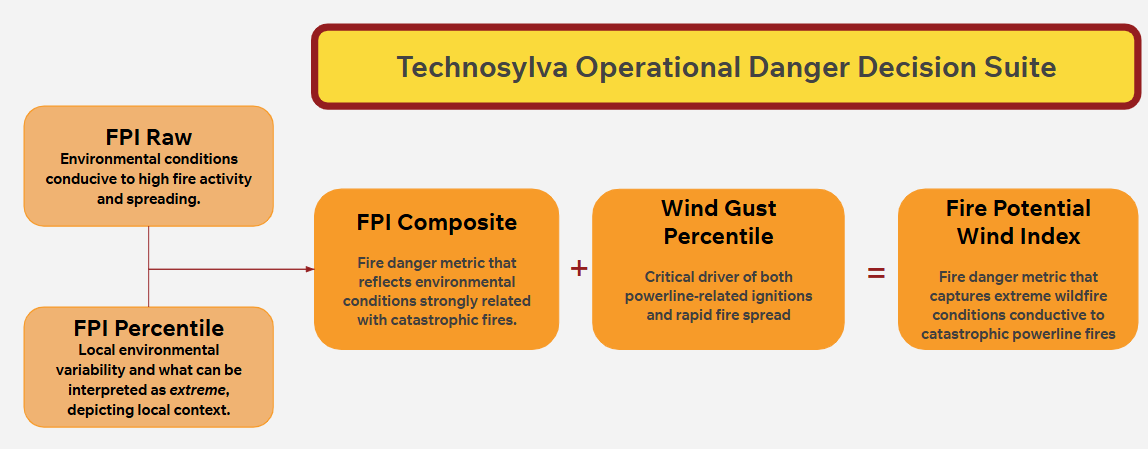
FPWI values are determined by the intersection of FPIC levels (1-5) and wind gust percentiles (0-100). The index design acknowledges that powerline fires often occur during the convergence of elevated fire danger conditions and extreme wind events.

FPWI values can be interpreted as follows:
-
FPWI 1 – Low wind-driven fire potential: Either fire potential is low, wind conditions are not elevated enough, or the combination of the two does not indicate meaningful wind-driven wildfire concern. For example, if FPIC is 1, FPWI stays 1 across all wind percentile ranges.
-
FPWI 2 – Elevated wind-driven fire potential: Fire potential and wind are beginning to overlap in a way that warrants increased awareness or monitoring, but conditions are not yet in the highest concern categories.
-
FPWI 3 – High wind-driven fire potential: Higher fire potential is coinciding with stronger or more unusual winds, increasing concern for ignition consequences and rapid spread.
-
FPWI 4 – Extreme wind-driven fire potential: High or extreme fire potential is coinciding with very strong/unusual winds. These are the infrequent, critical combinations FPWI is designed to highlight, especially for utility operational decisions such as PSPS review.